
FOR IMMEDIATE RELEASE: July 30, 2024
CONTACT: S.F. Public Defender’s Office | PDR-MediaRelations@sfgov.org
**PRESS RELEASE**

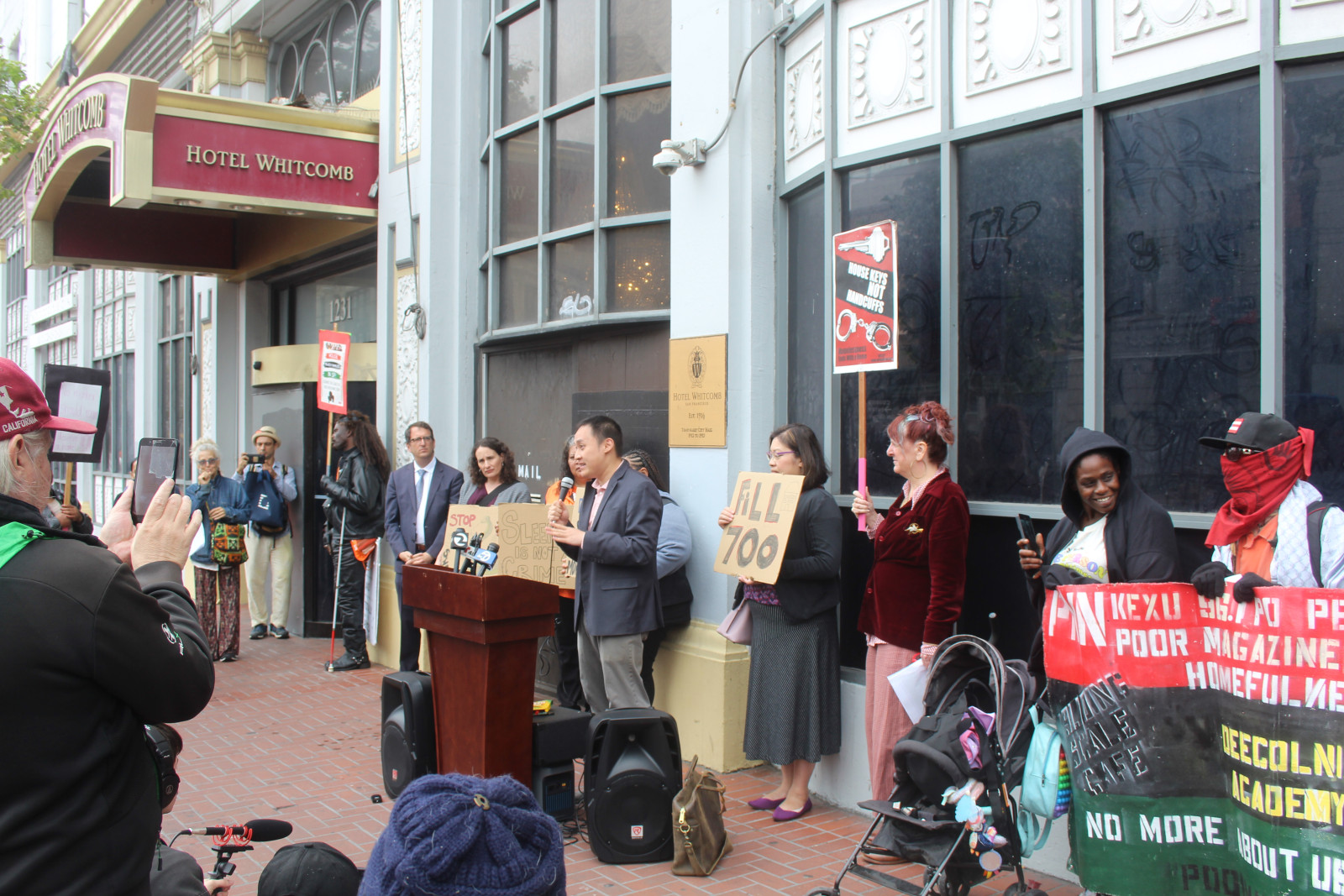
SAN FRANCISCO — Today, San Francisco community leaders held a press conference to denounce recent measures targeting the unhoused individuals. Speakers called for real and sustainable solutions to homelessness, emphasizing that criminalization is neither an effective nor humane approach. They demanded that San Francisco take immediate action to fill the more than 700+ vacant living spaces it controls in the city.
Today’s action came in response to Mayor London Breed’s announcement authorizing “aggressive” homeless camp sweeps and the criminal prosecution of unhoused individuals, as well as Gov. Gavin Newsom’s executive order directing cities to clear homeless encampments.
“Mayor Breed’s recent remarks about aggressively conducting homelessness sweeps and criminally charging the homeless were not only inhumane but counterproductive,” said Julia Arroyo, executive director of Young Women’s Freedom Center. “Criminalizing homelessness only exacerbates the problem and fails to address the root causes. These actions are a violation of basic human rights. Sweeps displace individuals without providing any sustainable solutions, leading to further instability, trauma, and often death.”
The event took place outside the Hotel Whitcomb in San Francisco, where 459 potential rooms for the unhoused sit unoccupied. Leaders from various community organizations addressed the many harmful impacts of current policies and proposed comprehensive strategies to tackle the root causes of homelessness.
“To end homelessness, elected officials must fill vacant units, expand all types of housing—acquisitions, rental assistance, and new construction,” said Jennifer Friedenbach, executive director of the Coalition on Homelessness, San Francisco. “They must provide rent relief to help people remain in their homes, and strengthen eviction protections. And yes, we also need more shelter—but shelter is only efficient if that expensive cost is sandwiched between prevention and housing, so stays in shelter are short and brief, and so many folks can avoid shelter altogether.”
Community leaders emphasized that rather than implementing punitive measures, the city should invest in affordable housing. Creating more housing units and ensuring they are accessible to low-income individuals and families is a fundamental step towards reducing homelessness. Leaders stressed that filling the currently vacant houses would provide immediate relief and stability for many.
“We will continue to demand that the government end its abuse of our unhoused neighbors,” said John Do, senior attorney for the Racial & Economic Justice Program at the ACLU of Northern California. “Everyone has the right to have personal property, and the government cannot seize or destroy personal belongings—whether survival gear, medication, personal IDs, work equipment, or sentimental family mementos. Gov. Newsom has endorsed Caltrans as a model for clearing encampments. This is concerning as Caltrans has a troubling history of destroying people’s belongings, a practice that led to a $1.3 million settlement with the ACLU and the Lawyers Committee [for Civil Rights]. We’ve fought—and won—this battle before, and we will do so again.”
Speakers at the event emphasized the urgent need for compassionate solutions to homelessness in San Francisco. They called for community-based solutions that involve input from those experiencing homelessness and engage the community to ensure that solutions are tailored to the actual needs of the homeless population.
“We cannot arrest our way out of the homelessness crisis, which is primarily caused by economic hardship and high housing costs,” said District 5 Supervisor Dean Preston. “We must urgently house people with the support they need, scaling up programs like Street-to-Home to fill vacant supportive housing units and meet people’s immediate need for housing.”
Community leaders called on Mayor Breed and the city administration to be transparent about their plans and to involve community organizations in the decision-making process. They expressed a strong belief that through collaboration and a commitment to human rights, San Francisco can create an environment where everyone has the opportunity to thrive.
Among the many organizations involved in this action were The Worker Agency, Young Women’s Freedom Center, the Coalition on Homelessness, the ACLU of Northern California, and the San Francisco Public Defender’s Office.